
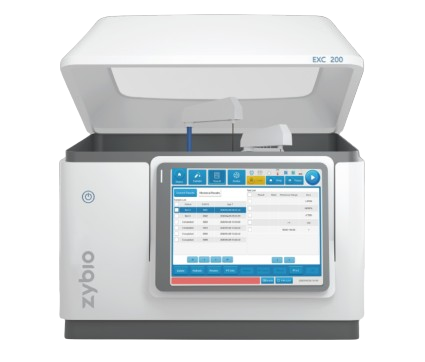
Zybio EXC200 Automated Desktop Chemistry Analyzer
The Zybio EXC200 is a compact, fully automated desktop chemistry analyzer delivering 240 tests/hour (single reagent) or 160 tests/hour (dual reagents) with 40-sample and 40-reagent positions. Ideal for small clinics and labs, it supports end-point, fixed-time, and kinetic methods, features a colorful touchscreen, 24-hour reagent refrigeration, and bi-directional LIS integration for efficient, space-saving clinical chemistry analysis of up to 300+ parameters.

Description
Test Methodologies: Versatile Assay Capabilities The Zybio EXC200 supports three core methodologies—end-point for static measurements like glucose or cholesterol, fixed-time (two-point) for rate-based assays such as ALT/AST enzymes, and kinetic for continuous monitoring of reactions like LDH or CK-MB—enabling comprehensive profiling of electrolytes, substrates, enzymes, lipids, and proteins. This flexibility accommodates routine panels (e.g., liver/kidney function, cardiac markers) and specialized tests, providing reliable results for diagnosing metabolic disorders, cardiovascular risks, or renal impairments in primary care or satellite facilities.
Parameters Measured: Capable of analyzing over 300 photometric parameters, including key panels: electrolytes (Na+, K+, Cl-, Ca2+), substrates (GLU, BUN, CREA, UA), enzymes (ALT, AST, ALP, GGT, AMY), proteins (TP, ALB, TBIL, DBIL), lipids (CHOL, TG, HDL, LDL), and immunoturbidimetric assays (CRP, ASO, RF). It employs colorimetric, turbidimetric, and immunoturbidimetric detection with LED-based spectrophotometry (340–700 nm wavelengths) for high sensitivity and low interference, generating calibration curves and QC charts for each parameter to ensure traceability and minimal intra-assay CV (<2%).
Sample Requirements: Processes 40 samples simultaneously in open or closed tubes (e.g., 5 mL primary/secondary vials), requiring 2–50 µL volumes per test—suitable for serum, plasma, urine, or CSF. Supports barcode scanning for positive ID, auto-dilution for high-concentration samples (up to 1:100), and STAT lane priority, minimizing manual pipetting and errors in low-volume settings like pediatric or geriatric testing.
Throughput: Achieves 240 tests per hour for single-reagent assays or 160 for dual-reagent protocols, optimized for small to medium labs handling 500–1,000 tests daily. The random-access design with continuous loading and probe mixing ensures uninterrupted workflows, with average TAT of 10–15 minutes per panel, ideal for urgent electrolyte imbalances or lipid profiles during outpatient rushes.
Technology: Utilizes grating spectrophotometry with 8 wavelengths for precise absorbance readings and minimal crosstalk, combined with a high-speed robotic arm for sample/reagent handling and integrated stirring to prevent bubble formation. The system features auto-washable reaction cuvettes (disposable or reusable, 180–360 cuvette wheel) and bubble detection for clean results, while the embedded PC with Windows OS enables real-time monitoring and self-diagnostics to reduce downtime.
User Interface and Storage: Features a 10.4-inch colorful touchscreen with intuitive icons, graphical menus, and multilingual support (up to 6 languages, including English, Spanish, and Chinese) for quick setup and navigation. Stores up to 1,000,000 results with patient demographics, curves, and QC data, accessible via searchable database; includes a built-in thermal printer for reports and USB/RS232/LAN ports for bi-directional LIS/HIS integration, exporting in PDF/CSV for electronic health records.
Reagent System: Accommodates 40 refrigerated positions (2–8°C, 24-hour stability) for liquid, ready-to-use reagents in R1/R2 formats, with continuous loading to avoid interruptions. Low-volume dispensing (1–300 µL) and dead-volume minimization cut waste by 30%, while on-board calibration and two-level QC controls ensure daily stability, simplifying inventory for cost-conscious labs.
Dimensions and Portability: Integrated all-in-one design measures 640 × 520 × 620 mm (W × D × H) at 50 kg, fitting seamlessly on standard benches in space-limited clinics. Low power consumption (≤300 VA) and quiet operation (<55 dB) support 24/7 use in ambient 15–30°C with 30–85% humidity.
- Throughput: 240 T/H (single reagent); 160 T/H (dual reagent).
- Detection Channel: Multi-wavelength spectrophotometry (8 channels).
- Detection Principle: Colorimetric, turbidimetric, immunoturbidimetric with end-point, fixed-time, and kinetic methods.
- Detection Items: Over 300 parameters across electrolytes, enzymes, substrates, lipids, and proteins; customizable panels with alarms for abnormal results.
- Built-in thermal printer, supports external printers. Multi-builtin report templates available.
- 1,000,000 sample results, including parameters, calibration curves, QC data, and patient information.
- Sample modes: Serum/plasma, urine, CSF; supports auto-dilution and STAT processing.