
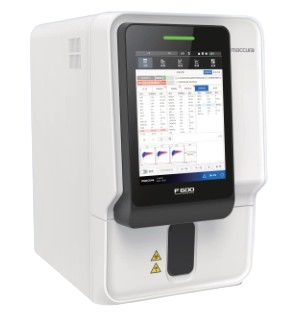
Maccura F600 5-Part Auto Hematology Analyzer
The Maccura F600 is a high-throughput 5-part hematology analyzer delivering 28 parameters + 4 histograms + scattergram at 60 tests/hour with 20 µL sample volume. Designed for mid-to-large hospitals, it features fluorescence flow cytometry + laser scatter for WBC diff, independent BASO channel, impedance for RBC/PLT, cyanide-free HGB, 10.4-inch touchscreen, 200,000-result storage, and built-in printer. Supports venous, capillary, and pre-diluted modes with multi-channel independence for reliable, interference-free diagnostics.

Description
5-Part Differentiation: Advanced White Blood Cell Subpopulation Analysis The Maccura F600 utilizes fluorescence staining and flow cytometry to provide true 5-part WBC differentiation, classifying neutrophils (NE# and NE%), eosinophils (EO# and EO%), basophils (BA# and BA%), monocytes (MO# and MO%), and lymphocytes (LY# and LY%). With an independent basophil channel to eliminate overlap with other leukocytes, it excels in detecting rare events like basophilia in myeloproliferative disorders or eosinophilic responses in parasitic infections, offering superior accuracy for comprehensive immune status assessment in hematology, oncology, and infectious disease workflows.
Parameters Measured: Assesses 28 parameters (24 reportable), including full CBC and differential: WBC, NE#, EO#, BA#, MO#, LY#, NE%, EO%, BA%, MO%, LY%, RBC, HGB (via eco-friendly cyanide-free spectrophotometry), HCT, MCV, MCH, MCHC, RDW-SD, RDW-CV, PLT, MPV, PDW, PCT, P-LCR, P-LCC, plus research parameters like immature granulocytes (IG%) and atypical lymphocytes (AL%). Produces four histograms (WBC, BASO, RBC, PLT) and a 2D scattergram for detailed morphological insights, with automated flags for blasts, variants, or inclusions to streamline review of complex cases like sepsis or bone marrow disorders.
Sample Requirements: Demands only 20 µL of sample, facilitating painless testing in neonates, geriatrics, or emergency scenarios. Fully supports venous whole blood for routine analysis, capillary blood for point-of-care convenience (e.g., heel or finger pricks), and pre-diluted modes for high-linearity samples, ensuring versatility and minimal hemolysis risks across all patient types.
Throughput: Delivers up to 60 samples per hour with seamless automation, tailored for high-volume labs processing 500–1,000 tests daily. Multi-channel parallel processing and rapid 50–70 second cycles handle peak demands without interruptions, while optional auto-sampler integration boosts efficiency for STAT orders in busy ERs or outpatient centers.
Technology: Integrates fluorescence nucleic acid staining + tri-angle laser scatter + hydrodynamic focusing flow cytometry for WBC differential, electrical impedance for RBC/PLT, and cyanide-free colorimetric method for HGB to enhance lab safety and sustainability. Independent channels minimize interferences, with advanced digital signal processing and AI-driven flagging achieving CVs <1.5% for precision parameters. The system’s gentle sample handling preserves fragile cells in aged or low-volume specimens, supported by automated QC and calibration traceability to ICSH standards.
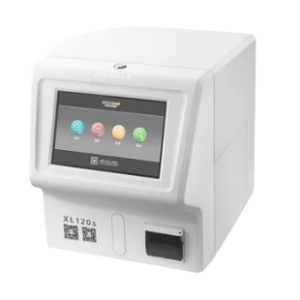
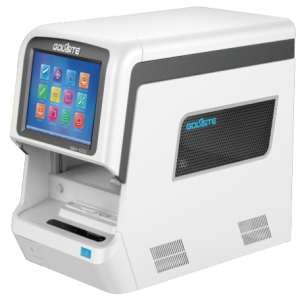
User Interface and Storage: Incorporates a 10.4-inch high-definition color touchscreen with graphical dashboards and multilingual interface (up to 12 languages, including English, French, German, and Chinese) for streamlined, training-minimal operation. Stores up to 200,000 patient results with comprehensive data—parameters, graphics, demographics, and QC trends—via searchable cloud-linked database. Built-in thermal printer generates customizable reports, with USB/LAN/RS232 ports enabling bi-directional LIS/HIS connectivity, HL7 compliance, and exports in PDF/XML for regulatory audits and telepathology.
Reagent System: Closed system with proprietary low-volume Maccura reagents (e.g., MAK diff lyse for 5-part, MAK diluent), featuring on-board monitoring to alert low stock and auto-dispense for zero waste. High-stability formulations extend shelf life to 6 months, with daily auto-rinsing and two-level controls reducing consumption by 40% and calibration frequency to weekly, optimizing costs in centralized lab operations.
Dimensions and Portability: Robust benchtop design at 450 × 400 × 550 mm (W × D × H) weighs 35 kg, fitting standard lab benches with optional wheeled cart for mobility. Operates at <58 dB on AC 100–240V with ≤200 VA power, enduring 5–40°C ambient and 20–85% humidity for deployment in diverse settings from urban hospitals to field clinics.
- Throughput: 60 samples/hour
- Detection Channel: Multi-channel (independent for WBC/DIFF/BASO, RBC/PLT).
- Detection Principle: Fluorescence staining + laser scatter + flow cytometry (WBC/DIFF/BASO), impedance method (RBC/PLT), cyanide-free colorimetric method (HGB).
- Detection Items: 28 parameters including 5-part CBC/DIFF (WBC, NE#, EO#, BA#, MO#, LY#, NE%, EO%, BA%, MO%, LY%, RBC, HGB, HCT, MCV, MCH, MCHC, RDW-SD, RDW-CV, PLT, MPV, PDW, PCT, P-LCR, P-LCC, IG%, AL%); 4 histograms + scattergram; alarms for abnormal cells, blasts, and variants.
- Built-in thermal printer, supports various types of printer. Multi-builtin print templates available.
- 200,000 sample results, including parameter, histogram, scattergram, and patient information.
- Counting modes: Venous whole blood, capillary whole blood, and pre-diluted.