
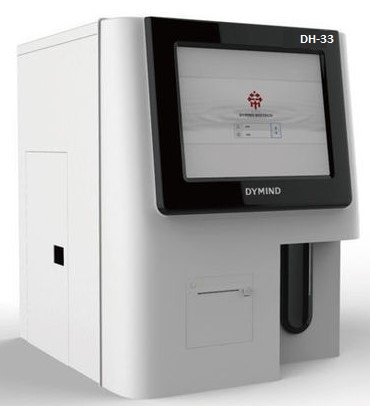
Dymind DH33 3-Part Auto Hematology Analyzer
Hematology analyzers are used widely in patient and research settings to count and characterize blood cells for disease detection and monitoring. Basic analyzers return a complete blood count (CBC) with a three-part differential white blood cell (WBC) count. Sophisticated analyzers measure cell morphology and can detect small cell populations to diagnose rare blood conditions.
Description
3-Part Differentiation: Provides a breakdown of white blood cells (WBC) into three categories—granulocytes, monocytes, and lymphocytes—along with counts for red blood cells (RBC) and platelets (PLT). This helps in detecting and monitoring conditions like infections, anemias, and blood disorders.
Parameters Measured: Analyzes 21 parameters, including WBC, RBC, HGB (hemoglobin using a cyanide-free method), HCT (hematocrit), PLT, and various indices like MCV (mean corpuscular volume), MCH (mean corpuscular hemoglobin), and MCHC (mean corpuscular hemoglobin concentration). It also generates 3 histograms for visual analysis of cell distribution.
Sample Requirements: Requires only 9 µL (microliters) of sample volume, making it suitable for pediatric or low-volume testing. Supports three sample modes: venous whole blood, capillary blood (e.g., fingerstick), and pre-diluted blood.
Throughput: Processes up to 60 samples per hour, ideal for small to medium-sized labs with moderate workloads.
Technology: Utilizes electrical impedance for WBC, RBC, and PLT counting; cyanide-free spectrophotometry for hemoglobin; and advanced features like pulse baseline tracking, waveform discrimination, and digital sheath flow for precise results.
User Interface and Storage: Features a 10.4-inch touchscreen for intuitive operation, with multilingual support (up to 6 languages). Stores up to 50,000 patient results, including parameters, histograms, and patient data. Includes a built-in thermal printer and USB connectivity for external printers and data export.
Reagent System: Open system compatible with Dymind’s low-consumption reagents (e.g., LYE-1 lyse). Built-in lyse and diluent positions reduce waste and simplify operation.
Dimensions and Portability: Compact design (typically around 30-40 cm in width/depth, under 50 cm height) for easy placement in labs. Weighs approximately 15-20 kg, with low power consumption.
- Throughput: 60 samples/hour
- Detection Channel: Dual-channel for counting.
- Detection principle: Impedance method (WBC/RBC/PLT) and cyanide free colorimetric method (HGB).
- Detection items: The detection items include 21 parameters: report parameters (WBC, Lym#, Mid#, Gran#, Lym%, Mid%, Gran%, RBC, HGB, HCT, MCV, MCH, MCHC, RDW-CV, RDW-SD, PLT, MPV,
PDW, PCT, P-LCR, and P-LCC), 3 histograms, alarm for abnormal erythrocytes, leukocyte and platelet.
-
Built-in thermal printer, supports various types of printer. Muti-builtin print templates available.
-
50,000 sample results, including parameter,histogram and patient information.
- Counting modes: Venous whole blood, capillary whole blood and pre-diluted.