
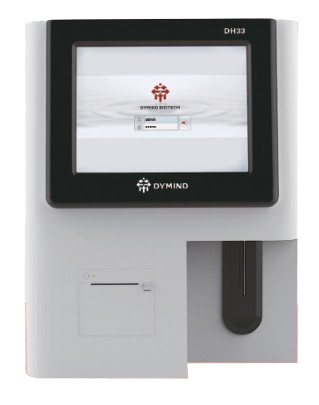
Dymind DH33 3-Part Auto Hematology Analyzer
The Dymind DH33 is a compact, fully automated 3-part hematology analyzer delivering 21 CBC parameters with 60 tests/hour using just 9 µL of blood. Ideal for small to mid-sized labs, it features cyanide-free HGB measurement, dual-channel impedance counting, 3 histograms, and 50,000-result storage on a 10.4-inch touchscreen. Supports venous, capillary, and pre-diluted modes with built-in printer and open reagent system for cost-effective, reliable daily diagnostics.

Description
3-Part Differentiation: Comprehensive White Blood Cell Analysis The Dymind DH33 delivers precise 3-part WBC differentiation into granulocytes (Gran# and Gran%), monocytes (Mid# and Mid%), and lymphocytes (Lym# and Lym%), complemented by absolute and percentage counts for red blood cells (RBC) and platelets (PLT). This configuration enables rapid screening for infections, inflammatory conditions, anemias, and clotting disorders, providing clinicians with actionable insights from a single run to support timely diagnosis and patient management in primary care, pediatrics, and outpatient settings.
Parameters Measured: Analyzes a full suite of 21 parameters, including core CBC metrics: WBC (total white blood cell count), RBC, HGB (hemoglobin via cyanide-free spectrophotometry for safer, eco-friendly operation), HCT (hematocrit), MCV (mean corpuscular volume), MCH (mean corpuscular hemoglobin), MCHC (mean corpuscular hemoglobin concentration), RDW-CV and RDW-SD (red cell distribution width), PLT, MPV (mean platelet volume), PDW (platelet distribution width), PCT (plateletcrit), P-LCR (platelet-large cell ratio), and P-LCC (platelet-large cell count). It generates three detailed histograms (WBC, RBC, PLT) for visual distribution analysis, plus intelligent alarms for abnormal flags in erythrocytes, leukocytes, and platelets, enhancing result interpretation and flagging potential pathologies like microcytic anemias or thrombocytopenias.
Sample Requirements: Requires a minimal 9 µL sample volume, ideal for pediatric, geriatric, or resource-limited testing where blood draw is challenging. Supports versatile modes including venous whole blood, capillary blood (e.g., fingerstick or heel prick for neonates), and pre-diluted samples, ensuring flexibility across diverse patient demographics and point-of-care scenarios without compromising accuracy.
Throughput: Processes up to 60 samples per hour in a compact, automated workflow, perfectly suited for small to mid-sized labs, clinics, or satellite facilities handling 200–500 tests daily. The continuous loading capability and rapid 30–45 second per-sample cycle minimize wait times, boosting operational efficiency during peak hours.
Technology: Employs proven electrical impedance for accurate counting of WBC, RBC, and PLT, paired with cyanide-free colorimetric spectrophotometry for HGB to reduce hazardous waste and operator exposure. Advanced digital technologies—pulse baseline tracking for noise reduction, waveform discrimination for cell type isolation, and digital sheath flow for precise sizing—deliver reliable results with low CV (<2% for most parameters). The dual-channel detection system further enhances specificity, while built-in quality control checks ensure traceability and minimal false positives.
User Interface and Storage: Boasts a responsive 10.4-inch color touchscreen with intuitive icons and multilingual support (up to 8 languages, including English, Spanish, French, and Chinese) for global usability. Stores up to 50,000 patient results with full details—parameters, histograms, scattergrams, and demographics—accessible via searchable database. Includes a built-in thermal printer for instant reports and USB/RS232 ports for seamless integration with LIS/HIS systems, external printers, and data export in PDF/CSV formats for electronic records.
Reagent System: Designed as an open system for compatibility with Dymind’s low-volume, cost-effective reagents like DYM-Lyse-1 (lyse) and DYM-Diluent-3, featuring dedicated on-board positions to minimize cross-contamination and waste. Auto-rinse cycles between samples and daily startup/shutdown routines extend calibration stability up to 24 hours, reducing reagent consumption by 30% compared to closed systems and simplifying inventory management.
Dimensions and Portability: Compact benchtop design measuring 260 × 385 × 435 mm (W × D × H) weighs just 14 kg, fitting effortlessly on standard lab counters or mobile carts for point-of-care deployment. Low power draw (70 VA) supports operation in areas with unstable electricity, and the quiet operation (<50 dB) ensures a distraction-free environment.
- Throughput: 60 samples/hour
- Detection Channel: Dual-channel for enhanced WBC/RBC/PLT discrimination.
- Detection Principle: Impedance method (WBC/RBC/PLT) and cyanide-free colorimetric method (HGB).
- Detection Items: 21 parameters including reportable CBC/DIFF (WBC, Lym#, Mid#, Gran#, Lym%, Mid%, Gran%, RBC, HGB, HCT, MCV, MCH, MCHC, RDW-CV, RDW-SD, PLT, MPV, PDW, PCT, P-LCR, P-LCC); 3 histograms; alarms for abnormal erythrocytes, leukocytes, and platelets.
- Built-in thermal printer, supports various types of printer. Multi-builtin print templates available.
- 50,000 sample results, including parameter, histogram and patient information.
- Counting modes: Venous whole blood, capillary whole blood and pre-diluted.